

Integrating sustainability: environmental and financial performance in BRICS energy and heavy industry
Abstract
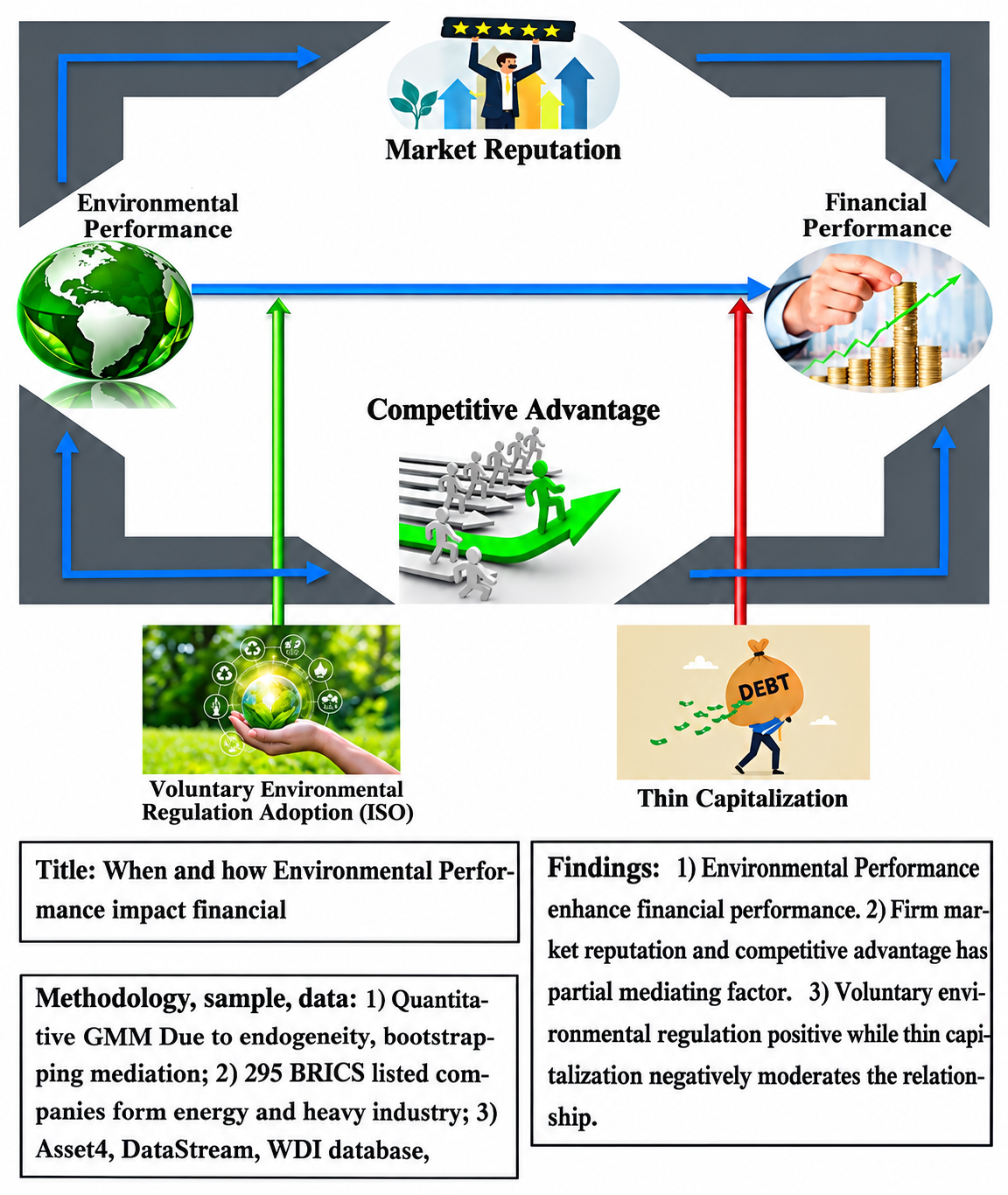
This study provides a clear and compelling analysis of how Environmental Performance (EP) drives Financial Performance (FP) in BRICS countries. It shows that strong EP reduces environmental risks, enhances value, and improves firms’ financial outcomes. Focusing on firm-level data, the study examines the EP-FP link with market reputation and competitive advantage as mediators, and thin capitalization and voluntary environmental regulation adoption as moderators. Using the Generalized Method of Moments and bootstrap- ping on 295 BRICS firms (2015–2022), the results confirm that EP positively influences both accounting- and market-based FP, with a stronger and slightly delayed effect on accounting measures. The study also finds that market reputation and competitive advantage partially mediate this relationship. Moreover, voluntary environmental regulation strengthens the EP-FP link, while thin capitalization weakens it. We found that firms with roust environmental initiatives have potential competitive strength that foster stronger reputations thus secure positive financial gains. The insights of this research underscore the significance of adopting forward- looking, sustainability-focused strategies that rise above narrow, short-term profit objectives. The findings offer valuable guidance for managers, companies, and policymakers seeking to improve environmental and financial outcomes.
Keywords:
environmental performance, mediator, market reputation, competitive advantage, moderator, voluntary environmental regulation adoption, thin capitalization, BRICS, GMMHow to Cite
Share
License
Copyright (c) 2026 The Author(s). Published by Vilnius Gediminas Technical University.

This work is licensed under a Creative Commons Attribution 4.0 International License.
References
Abban, A. R., & Hasan, M. Z. (2021). The causality direction between environmental performance and financial performance in Australian mining companies – A panel data analysis. Resources Policy, 70, Article 101894. https://doi.org/10.1016/j.resourpol.2020.101894
Abdelbaky, A., Liu, T., Mingyang, X., Shahzad, M. F., & Hassanein, A. (2025). Real earnings management and ESG performance in China: The mediating role of corporate innovations. International Journal of Finance & Economics, 30(4), 3476–3499. https://doi.org/10.1002/ijfe.3074
Aigbedo, H. (2021). An empirical analysis of the effect of financial performance on environmental performance of companies in global supply chains. Journal of Cleaner Production, 278, Article 121741. https://doi.org/10.1016/j.jclepro.2020.121741
Arfazil, M., Saputra, M., & Indayani. (2022). The effects of environmental performance, financial leverage, and institutional ownership on firm value: A study on manufacturing firms in Indonesia. Journal of Contemporary Accounting, 3(3), 162–168. https://doi.org/10.20885/jca.vol3.iss3.art5
Arimura, T. H., Kaneko, S., Managi, S., Shinkuma, T., Yamamoto, M., & Yoshida, Y. (2019). Political economy of voluntary approaches: A lesson from environmental policies in Japan. Economic Analysis and Policy, 64, 41–53. https://doi.org/10.1016/j.eap.2019.07.003
Arocena, P., Orcos, R., & Zouaghi, F. (2021). The impact of ISO 14001 on firm environmental and economic performance: The moderating role of size and environmental awareness. Business Strategy and the Environment, 30(2), 955–967. https://doi.org/10.1002/bse.2663
Arora, N., Saggar, R., & Singh, B. (2021). Nexus between risk disclosure and corporate reputation: A longitudinal approach. Journal of Strategy and Management, 14(4), 529–544. https://doi.org/10.1108/JSMA-06-2020-0162
Aslam, S., Elmagrhi, M. H., Rehman, R. U., & Ntim, C. G. (2021). Environmental management practices and financial performance using data envelopment analysis in Japan: The mediating role of environmental performance. Business Strategy and the Environment, 30(4), 1655–1673. https://doi.org/10.1002/bse.2700
Ayayi, A. G., & Wijesiri, M. (2022). Is there a trade-off between environmental performance and financial sustainability in microfinance institutions? Evidence from South and Southeast Asia. Business Strategy and the Environment, 31(4), 1552–1565. https://doi.org/10.1002/bse.2969
Baah, C., Opoku-Agyeman, D., Acquah, I. S. K., Agyabeng-Mensah, Y., Afum, E., Faibil, D., & Abdoulaye, F. A. M. (2021). Examining the correlations between stakeholder pressures, green production practices, firm reputation, environmental and financial performance: Evidence from manufacturing SMEs. Sustainable Production and Consumption, 27, 100–114. https://doi.org/10.1016/j.spc.2020.10.015
Bae, K.-H., El Ghoul, S., Guedhami, O., Kwok, C. C. Y., & Zheng, Y. (2019). Does corporate social responsibility reduce the costs of high leverage? Evidence from capital structure and product market interactions. Journal of Banking and Finance, 100, 135–150. https://doi.org/10.1016/j.jbankfin.2018.11.007
Banerjee, R., & Gupta, K. (2019). The effect of environmentally sustainable practices on firm R&D: International evidence. Economic Modelling, 78, 262–274. https://doi.org/10.1016/j.econmod.2018.09.024
Barney, J. (1991). Firm resources and sustained competitive advantage. Journal of Management, 17(1), 99–120. https://doi.org/10.1177/014920639101700108
Bassetti, T., Blasi, S., & Sedita, S. R. (2021). The management of sustainable development: A longitudinal analysis of the effects of environmental performance on economic performance. Business Strategy and the Environment, 30(1), 21–37. https://doi.org/10.1002/bse.2607
Ben Lahouel, B., Ben Zaied, Y., Managi, S., & Taleb, L. (2022). Re-thinking about U: The relevance of regime-switching model in the relationship between environmental corporate social responsibility and financial performance. Journal of Business Research, 140, 498–519. https://doi.org/10.1016/j.jbusres.2021.11.019
Benameur, K. B., Mostafa, M. M., Hassanein, A., Shariff, M. Z., & Al-Shattarat, W. (2024). Sustainability reporting scholarly research: A bibliometric review and a future research agenda. Management Review Quarterly, 74, 823–866. https://doi.org/10.1007/s11301-023-00319-7
Benameur, K., Hassanein, A., Mostafa, M. M., Elmaghrabi, M., & Tharwat, H. (2025). A decade of sustainable finance scholarly research: Performance analysis, science mapping and future pathways. Journal of Financial Reporting and Accounting. https://doi.org/10.1108/JFRA-10-2024-0722
Bendig, D., Wagner, A., & Lau, K. (2023). Does it pay to be science-based green? The impact of science-based emission-reduction targets on corporate financial performance. Journal of Industrial Ecology, 27(1), 125–140. https://doi.org/10.1111/jiec.13341
Benkraiem, R., Dubocage, E., Lelong, Y., & Shuwaikh, F. (2023). The effects of environmental performance and green innovation on corporate venture capital. Ecological Economics, 210, Article 107860. https://doi.org/10.1016/j.ecolecon.2023.107860
Blundell, R., & Bond, S. (2023). Reprint of: Initial conditions and moment restrictions in dynamic panel data models. Journal of Econometrics, 234, 38–55. https://doi.org/10.1016/j.jeconom.2023.03.001
Boshnak, H. (2023). The impact of capital structure on firm performance: Evidence from Saudi-listed firms. International Journal of Disclosure and Governance, 20, 15–26. https://doi.org/10.1057/s41310-022-00154-4
Busch, T., & Lewandowski, S. (2018). Corporate carbon and financial performance a meta-analysis. Journal of Industrial Ecology, 22(4), 745–759. https://doi.org/10.1111/jiec.12591
Cantele, S., & Zardini, A. (2018). Is sustainability a competitive advantage for small businesses? An empirical analysis of possible mediators in the sustainability–financial performance relationship. Journal of Cleaner Production, 182, 166–176. https://doi.org/10.1016/j.jclepro.2018.02.016
Chen, P. H., Ong, C. F., & Hsu, S. C. (2016). Understanding the relationships between environmental management practices and financial performances of multinational construction firms. Journal of Cleaner Production, 139, 750–760. https://doi.org/10.1016/j.jclepro.2016.08.109
Chikán, A., Czakó, E., Kiss-Dobronyi, B., & Losonci, D. (2022). Firm competitiveness: A general model and a manufacturing application. International Journal of Production Economics, 243, Article 108316. https://doi.org/10.1016/j.ijpe.2021.108316
Dai, J., Mehmood, U., & Nassani, A. A. (2025a). Empowering sustainability through energy efficiency, green innovations, and the sharing economy: Insights from G7 economies. Energy, 318, Article 134768. https://doi.org/10.1016/j.energy.2025.134768
Dai, J., Zhou, B., & Meng, W. (2025b). The impact of digitization on environmental sustainability: New insights from G20 nations. Journal of Environmental Management, 394, Article 127225. https://doi.org/10.1016/j.jenvman.2025.127225
Danso, A., Adomako, S., Lartey, T., Amankwah-Amoah, J., & Owusu-Yirenkyi, D. (2020). Stakeholder integration, environmental sustainability orientation and financial performance. Journal of Business Research, 119, 652–662. https://doi.org/10.1016/j.jbusres.2019.02.038
De Leaniz, P. M. G., & Del Bosque Rodríguez, I. R. (2016). Corporate image and reputation as drivers of customer loyalty. Corporate Reputation Review, 19, 166–178. https://doi.org/10.1057/crr.2016.2
Dixon-Fowler, H. R., Slater, D. J., Johnson, J. L., Ellstrand, A. E., & Romi, A. M. (2013). Beyond “does it pay to be green?” A meta-analysis of moderators of the CEP-CFP relationship. Journal of Business Ethics, 112, 353–366. https://doi.org/10.1007/s10551-012-1268-8
El Khoury, R., Nasrallah, N., & Alareeni, B. (2023). ESG and financial performance of banks in the MENAT region: Concavity–convexity patterns. Journal of Sustainable Finance and Investment, 13(1), 406–430. https://doi.org/10.1080/20430795.2021.1929807
Esposito, P., Dicorato, S. L., & Doronzo, E. (2021). The effect of ownership on sustainable development and environmental policy in urban waste management: An explicatory empirical analysis of Italian municipal corporations. Business Strategy and the Environment, 30(2), 1067–1079. https://doi.org/10.1002/bse.2671
Feng, M., Yu, W., Wang, X., Wong, C. Y., Xu, M., & Xiao, Z. (2018). Green supply chain management and financial performance: The mediating roles of operational and environmental performance. Business Strategy and the Environment, 27(7), 811–824. https://doi.org/10.1002/bse.2033
Elmaghrabi, M., Hassanein, A., & Diab, A. (2025). How do firm-level and country-level sustainability governance shape corporate sustainability? Insights from environmentally-sensitive industries. Social Responsibility Journal, 21(5), 1086–1110. https://doi.org/10.1108/SRJ-02-2024-0088
Fernández-Cuesta, C., Castro, P., Tascón, M. T., & Castaño, F. J. (2019). The effect of environmental performance on financial debt. European evidence. Journal of Cleaner Production, 207, 379–390. https://doi.org/10.1016/j.jclepro.2018.09.239
Friedman, M. (2017). The social responsibility of business is to increase its profits. In W. C. Zimmerli, M. Holzinger, & K. Richter (Eds.), Corporate ethics and corporate governance (pp. 173–178). Springer. https://doi.org/10.1007/978-3-540-70818-6_14
Gupta, R. D., & Deb, S. G. (2023). Interlinkage between corporate social, environmental performance and financial performance: Firm-mediators in a multi-country context. Finance Research Letters, 52, Article 103386. https://doi.org/10.1016/j.frl.2022.103386
Haibo, C., & Manu, E. K. (2022). The impact of banks’ financial performance on environmental performance in Africa. Environmental Science and Pollution Research, 29, 49214–49233. https://doi.org/10.1007/s11356-022-19401-w
Hart, S. L. (1995). A natural-resource-based view of the firm. Academy of Management Review, 20(4), 986–1014. https://doi.org/10.2307/258963
Hart, S. L., & Ahuja, G. (1996). Does it pay to be green? An empirical examination of the relationship between emission reduction and firm performance. Business Strategy and the Environment, 5(1), 30–37. https://doi.org/10.1002/(sici)1099-0836(199603)5:1<30::aid-bse38>3.0.co;2-q
Hart, S. L., & Dowell, G. (2011). Invited editorial: A natural-resource-based view of the firm: Fifteen years after. Journal of Management, 37(5), 1464–1479. https://doi.org/10.1177/0149206310390219
Hasan, R., Miah, M. D., & Hassan, M. K. (2022). The nexus between environmental and financial performance: Evidence from gulf cooperative council banks. Business Strategy and the Environment, 31(7), 2882–2907. https://doi.org/10.1002/bse.3053
Hassanein, A., & Elmaghrabi, M. (2025). How does market competition affect the reporting of sustainability practices? Insights from the UK and Germany. International Journal of Productivity and Performance Management, 74(4), 1452–1474. https://doi.org/10.1108/IJPPM-07-2023-0369
Hassanein, A., & Elsayed, N. (2025). Reporting ESG initiatives and gender diversity in Germany: Implications for stock liquidity. International Journal of Finance & Economics, 31(2), 2824–2844. https://doi.org/10.1002/ijfe.70009
Hassanein, A., Bani-Mustafa, A., & Nimer, K. (2024). A country’s culture and reporting of sustainability practices in energy industries: Does a corporate sustainability committee matter?. Humanities and Social Sciences Communications, 11, Article 1140. https://doi.org/10.1057/s41599-024-03536-x
Johnstone, L., & Hallberg, P. (2020). ISO 14001 adoption and environmental performance in small to medium sized enterprises. Journal of Environmental Management, 266, Article 110592. https://doi.org/10.1016/j.jenvman.2020.110592
Lane, D. (2009). The cost of capital, corporation finance and the theory of investment: A refinement. Applied Economics Letters, 16(10), 1017–1019. https://doi.org/10.1080/17446540802345448
Long, W., Luo, L., Sun, H., & Zhong, Q. (2023). Does going abroad lead to going green? Firm outward foreign direct investment and domestic environmental performance. Business Strategy and the Environment, 32(1), 484–498. https://doi.org/10.1002/bse.3156
López-Gamero, M. D., Molina-Azorín, J. F., & Claver-Cortés, E. (2009). The whole relationship between environmental variables and firm performance: Competitive advantage and firm resources as mediator variables. Journal of Environmental Management, 90(10), 3110–3121. https://doi.org/10.1016/j.jenvman.2009.05.007
Lu, Y., Li, G., Luo, Z., Anwar, M., & Zhang, Y. (2021). Does intellectual capital spur sustainable competitive advantage and sustainable growth?: A study of Chinese and Pakistani firms. SAGE Open, 11(1). https://doi.org/10.1177/2158244021996702
Madsen, H., & Ulhøi, J. P. (2001). Integrating environmental and stakeholder management. Business Strategy and the Environment, 10(2), 77–88. https://doi.org/10.1002/bse.279
Manrique, S., & Martí-Ballester, C.-P. (2017). Analyzing the effect of corporate environmental performance on corporate financial performance in developed and developing countries. Sustainability, 9(11), Article 1957. https://doi.org/10.3390/su9111957
Mardiana, A. (2021). The impact of corporate reputation on the cost of equity as mediated by earnings quality. Atestasi: Jurnal Ilmiah Akuntansi, 4(2), 217–229. https://doi.org/10.57178/atestasi.v4i2.268
Marsat, S., Pijourlet, G., & Ullah, M. (2021). Is there a trade-off between environmental performance and financial resilience? International evidence from the subprime crisis. Accounting and Finance, 61(3), 4061–4084. https://doi.org/10.1111/acfi.12726
Martínez, P., & Rodríguez del Bosque, I. (2014). Sustainability dimensions: A source to enhance corporate reputation. Corporate Reputation Review, 17, 239–253. https://doi.org/10.1057/crr.2014.13
Miroshnychenko, I., De Massis, A., Barontini, R., & Testa, F. (2022). Family firms and environmental performance: A meta-analytic review. Family Business Review, 35(1), 68–90. https://doi.org/10.1177/08944865211064409
Nassani, A. A., Aldakhil, A. M., Qazi Abro, M. M., & Zaman, K. (2017). Environmental Kuznets curve among BRICS countries: Spot lightening finance, transport, energy and growth factors. Journal of Cleaner Production, 154, 474–487. https://doi.org/10.1016/j.jclepro.2017.04.025
Neves, M. E. D., Reis, S., Reis, P., & Dias, A. G. (2024). Impact of ISO 14001 and ISO 9001 adoption on corporate performance: Evidence on a bank-based system. International Journal of Productivity and Performance Management, 73(5), 1641–1667. https://doi.org/10.1108/IJPPM-08-2022-0398
Nguyen, T. H. H., Elmagrhi, M. H., Ntim, C. G., & Wu, Y. (2021). Environmental performance, sustainability, governance and financial performance: Evidence from heavily polluting industries in China. Business Strategy and the Environment, 30(5), 2313–2331. https://doi.org/10.1002/bse.2748
Nishitani, K., Jannah, N., Kaneko, S., & Hardinsyah. (2017). Does corporate environmental performance enhance financial performance? An empirical study of Indonesian firms. Environmental Development, 23, 10–21. https://doi.org/10.1016/j.envdev.2017.06.003
Orlitzky, M., Louche, C., Gond, J. P., & Chapple, W. (2017). Unpacking the drivers of corporate social performance: A multilevel, multistakeholder, and multimethod analysis. Journal of Business Ethics, 144, 21–40. https://doi.org/10.1007/s10551-015-2822-y
Porter, M. E., & Van Der Linde, C. (1995). Toward a new conception of the environment-competitiveness relationship. Journal of Economic Perspectives, 9(4), 97–118. https://doi.org/10.1257/jep.9.4.97
Preacher, K. J., & Hayes, A. F. (2008). Asymptotic and resampling strategies for assessing and comparing indirect effects in multiple mediator models. Behavior Research Methods, 40, 879–891. https://doi.org/10.3758/BRM.40.3.879
Ramli, N. A., Latan, H., & Solovida, G. T. (2019). Determinants of capital structure and firm financial performance – A PLS-SEM approach: Evidence from Malaysia and Indonesia. Quarterly Review of Economics and Finance, 71, 148–160. https://doi.org/10.1016/j.qref.2018.07.001
Rehman, Z. ur, Khan, A., & Rahman, A. (2020). Corporate social responsibility’s influence on firm risk and firm performance: The mediating role of firm reputation. Corporate Social Responsibility and Environmental Management, 27(6), 2991–3005. https://doi.org/10.1002/csr.2018
Rezende, L. de A., Bansi, A. C., Alves, M. F. R., & Galina, S. V. R. (2019). Take your time: Examining when green innovation affects financial performance in multinationals. Journal of Cleaner Production, 233, 993–1003. https://doi.org/10.1016/j.jclepro.2019.06.135
Saeidi, S. P., Sofian, S., Saeidi, P., Saeidi, S. P., & Saaeidi, S. A. (2015). How does corporate social responsibility contribute to firm financial performance? The mediating role of competitive advantage, reputation, and customer satisfaction. Journal of Business Research, 68(2), 341–350. https://doi.org/10.1016/j.jbusres.2014.06.024
Tahat, Y. A., & Hassanein, A. (2024). Exploring the synergy of corporate gender diversity, sustainability committee, and reporting ESG practices: An international evidence. Journal of Environmental Management, 371, Article 123093. https://doi.org/10.1016/j.jenvman.2024.123093
Trumpp, C., & Guenther, T. (2017). Too little or too much? Exploring U-shaped relationships between corporate environmental performance and corporate financial performance. Business Strategy and the Environment, 26(1), 49–68. https://doi.org/10.1002/bse.1900
Tucker, L., & Melewar, T. C. (2005). Corporate reputation and crisis management: The threat and manageability of anti-corporatism. Corporate Reputation Review, 7, 377–387. https://doi.org/10.1057/palgrave.crr.1540233
Udeagha, M. C., & Ngepah, N. (2023). The drivers of environmental sustainability in BRICS economies: Do green finance and fintech matter? World Development Sustainability, 3, Article 100096. https://doi.org/10.1016/j.wds.2023.100096
Ullah, S., Zaefarian, G., & Ullah, F. (2021). How to use instrumental variables in addressing endogeneity? A step-by-step procedure for non-specialists. Industrial Marketing Management, 96, A1–A6. https://doi.org/10.1016/j.indmarman.2020.03.006
Wagner, M., Van Phu, N., Azomahou, T., & Wehrmeyer, W. (2002). The relationship between the environmental and economic performance of firms: An empirical analysis of the European paper industry. Corporate Social Responsibility and Environmental Management, 9(3), 133–146. https://doi.org/10.1002/csr.22
Wang, C., & Lin, Y. (2022). Does bargaining power mitigate the relationship between environmental regulation and firm performance? Evidence from China. Journal of Cleaner Production, 331, Article 129859. https://doi.org/10.1016/j.jclepro.2021.129859
Wang, J.-X., & Zhao, M.-Z. (2020). Economic impacts of ISO 14001 certification in China and the moderating role of firm size and age. Journal of Cleaner Production, 274, Article 123059. https://doi.org/10.1016/j.jclepro.2020.123059
Wedari, L. K., Moradi-Motlagh, A., & Jubb, C. (2023). The moderating effect of innovation on the relationship between environmental and financial performance: Evidence from high emitters in Australia. Business Strategy and the Environment, 32(1), 654–672. https://doi.org/10.1002/bse.3167
Windmeijer, F. (2005). A finite sample correction for the variance of linear efficient two-step GMM estimators. Journal of Econometrics, 126(1), 25–51. https://doi.org/10.1016/j.jeconom.2004.02.005
Zakharov, S. V., Lushpey, V. P., Abbasova, L. R., & Zhongkai, S. (2022). Analysis of the impact of the energy industry on the environment. IOP Conference Series: Earth and Environmental Science, 1070, Article 012044. https://doi.org/10.1088/1755-1315/1070/1/012044
Zhang, Y., Wei, J., Zhu, Y., & George-Ufot, G. (2020). Untangling the relationship between corporate environmental performance and corporate financial performance: The double-edged moderating effects of environmental uncertainty. Journal of Cleaner Production, 263, Article 121584. https://doi.org/10.1016/j.jclepro.2020.121584
Zheng, H., & He, Y. (2022). How do the China pollution discharge fee policy and the environmental protection tax law affect firm performance during the transitional period? Environmental Science and Pollution Research, 29, 44541–44557. https://doi.org/10.1007/s11356-022-19050-z
View article in other formats
CrossMark check

Published
Issue
Section
Copyright
Copyright (c) 2026 The Author(s). Published by Vilnius Gediminas Technical University.
License
This work is licensed under a Creative Commons Attribution 4.0 International License.