

Trust in the digital age: how cybersecurity governance willingness shapes trade credit – evidence from supplier credit decisions
Abstract
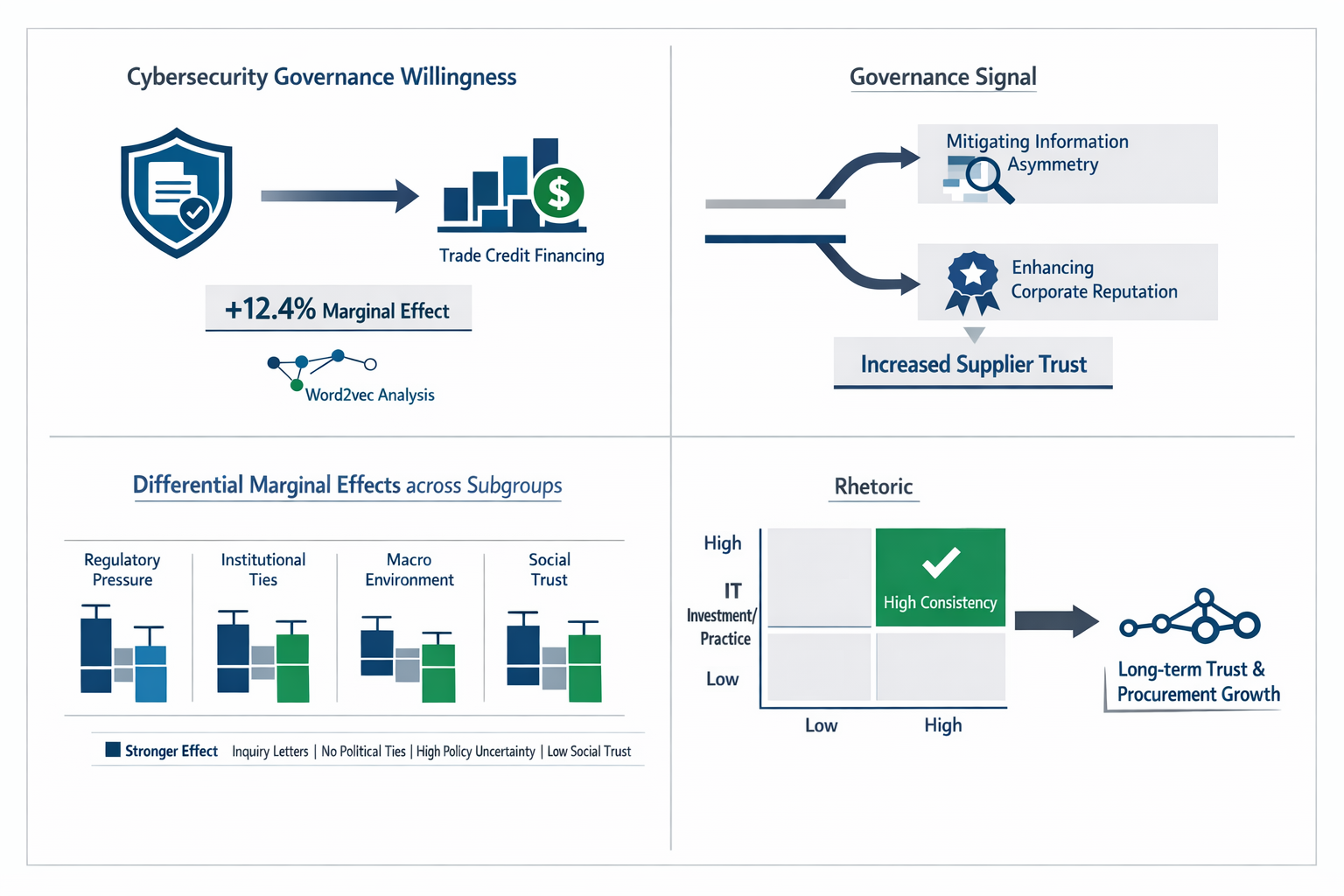
In the digital economy, the importance of robust cybersecurity governance for corporate financing stability has become increasingly salient. Using a sample of Chinese A-share listed companies from 2011 to 2023, we employ the Word2vec natural language processing technique to develop a measure of corporate cybersecurity governance commitment. Our study empirically examines its impact on trade credit financing. The results indicate that a firm’s expressed commitment to cybersecurity governance is positively associated with the trade credit it receives from suppliers. We find that information asymmetry and corporate reputation are key mechanisms through which this effect operates. Heterogeneity analysis reveals that this effect is more pronounced for firms that have received regulatory inquiry letters, those without political ties, those operating during periods of high economic policy uncertainty, and those located in regions with low social trust. Furthermore, we show that when firms’ stated commitments align with their actions, suppliers adjust their business relationships by allocating a greater share of procurement volume to them, thereby strengthening long-term supply chain trust. Our findings offer valuable insights for firms in emerging economies seeking to enhance their cybersecurity governance and optimize their financing environment.
Keywords:
cybersecurity governance commitment, supplier credit, trade credit, signaling theory, Word2vec text analysis, corporate reputationHow to Cite
Share
License
Copyright (c) 2026 The Author(s). Published by Vilnius Gediminas Technical University.

This work is licensed under a Creative Commons Attribution 4.0 International License.
References
Alfaro, L., García-Santana, M., & Moral-Benito, E. (2021). On the direct and indirect real effects of credit supply shocks. Journal of Financial Economics, 139(3), 895–921. https://doi.org/10.1016/j.jfineco.2020.09.004
Ball, R., Jayaraman, S., & Shivakumar, L. (2012). Audited financial reporting and voluntary disclosure as complements: A test of the confirmation hypothesis. Journal of Accounting & Economics, 53(1–2), 136–166. https://doi.org/10.1016/j.jacceco.2011.11.005
Baron, R. M., & Kenny, D. A. (1986). The moderator–mediator variable distinction in social psychological research: Conceptual, strategic, and statistical considerations. Journal of Personality and Social Psychology, 51(6), 1173–1182. https://doi.org/10.1037/0022-3514.51.6.1173
Benmelech, E., Meisenzahl, R. R., & Ramcharan, R. (2017). The real effects of liquidity during the financial crisis: Evidence from automobiles. Quarterly Journal of Economics, 132(1), 317–365. https://doi.org/10.1093/qje/qjw031
Berkman, H., Jona, J., Lee, G., & Soderstrom, N. (2018). Cybersecurity awareness and market valuations. Journal of Accounting and Public Policy, 37(6), 508–526. https://doi.org/10.1016/j.jaccpubpol.2018.10.003
Bharath, S. T., & Shumway, T. (2008). Forecasting default with the Merton distance to default model. The Review of Financial Studies, 21(3), 1339–1369. https://doi.org/10.1093/rfs/hhn044
Blind, K., Niebel, C., & Rammer, C. (2024). The impact of the EU General data protection regulation on product innovation. Industry and Innovation, 31(3), 311–351. https://doi.org/10.1080/13662716.2023.2271858
Cavusoglu, H., Mishra, B., & Raghunathan, S. (2004). The effect of internet security breach announcements on market value: Capital market reactions for breached firms and internet security developers. International Journal of Electronic Commerce, 9(1), 70–104. https://doi.org/10.1080/10864415.2004.11044320
China Academy of Information and Communications Technology. (2023). Research Report on China’s Digital Economy (2023). https://www.caict.ac.cn/kxyj/qwfb/bps/202304/t20230427_419051.htm
Chen, C., Kim, J., Wei, M., & Zhang, H. (2019). Linguistic information quality in customers’ forward‐looking disclosures and suppliers’ investment decisions. Contemporary Accounting Research, 36(3), 1751–1783. https://doi.org/10.1111/1911-3846.12471
Chen, J., Zhu, D., Ding, S., & Qu, J. (2024). Government environmental concerns and corporate green innovation: Evidence from heavy-polluting enterprises in China. Business Strategy and the Environment, 33(3), 1920–1936. https://doi.org/10.1002/bse.3583
Chen, J., Guo, X., Geng, Y., & Liu, R. (2025). Climate risk and trade credit financing: Evidence from China. International Journal of Finance & Economics, 30(3), 2514–2535. https://doi.org/10.1002/ijfe.3027
Chen, X., & Cheng, X. (2024). How does the digital economy affect corporate business credit supply? Journal of Business Economics and Management, 25(4), 685–708. https://doi.org/10.3846/jbem.2024.22027
Chernozhukov, V., Chetverikov, D., Demirer, M., Duflo, E., Hansen, C., Newey, W., & Robins, J. (2018). Double/debiased machine learning for treatment and structural parameters. The Econometrics Journal, 21(1), C1–C68. https://doi.org/10.1111/ectj.12097
Crosignani, M., Macchiavelli, M., & Silva, A. F. (2023). Pirates without borders: The propagation of cyberattacks through firms’ supply chains. Journal of Financial Economics, 147(2), 432–448. https://doi.org/10.1016/j.jfineco.2022.12.002
Deloitte. (2021). Technology, media, and telecommunications predictions 2021. https://branden.biz/wp-content/uploads/2020/12/PL_2021-TMT-predictions.pdf
Di Giuli, A., & Laux, P. A. (2022). The effect of media-linked directors on financing and external governance. Journal of Financial Economics, 145(2), 103–131. https://doi.org/10.1016/j.jfineco.2021.07.017
Dhillon, G., & Backhouse, J. (2001). Current directions in IS security research: Towards socio‐organizational perspectives. Information Systems Journal, 11(2), 127–153. https://doi.org/10.1046/j.1365-2575.2001.00099.x
Eisenbach, T. M., Kovner, A., & Lee, M. J. (2022). Cyber risk and the US financial system: A pre-mortem analysis. Journal of Financial Economics, 145(3), 802–826. https://doi.org/10.1016/j.jfineco.2021.10.007
Feldman, R., Govindaraj, S., Livnat, J., & Segal, B. (2010). Management’s tone change, post earnings announcement drift and accruals. Review of Accounting Studies, 15, 915–953. https://doi.org/10.1007/s11142-009-9111-x
Fisman, R., & Love, I. (2003). Trade credit, financial intermediary development, and industry growth. Journal of Finance, 58(1), 353–374. https://doi.org/10.1111/1540-6261.00527
Florackis, C., Louca, C., Michaely, R., & Weber, M. (2023). Cybersecurity risk. The Review of Financial Studies, 36(1), 351–407. https://doi.org/10.1093/rfs/hhac024
Garg, P. (2020). Cybersecurity breaches and cash holdings: Spillover effect. Financial Management, 49(2), 503–519. https://doi.org/10.1111/fima.12274
Gatzert, N., & Schubert, M. (2022). Cyber risk management in the US banking and insurance industry: A textual and empirical analysis of determinants and value. Journal of Risk and Insurance, 89(3), 725–763. https://doi.org/10.1111/jori.12381
Gordon, L. A., Loeb, M. P., & Sohail, T. (2010). Market value of voluntary disclosures concerning information security. MIS Quarterly, 34(3), 567–594. https://doi.org/10.2307/25750692
Hendijani Zadeh, M., Naaman, K., & Sahyoun, N. (2023). Corporate social responsibility transparency and trade credit financing. International Journal of Accounting & Information Management, 31(2), 247–269. https://doi.org/10.1108/IJAIM-05-2022-0099
IBM. (2024). Cost of a data breach report 2024. https://www.ibm.com/reports/data-breach
Janakiraman, R., Lim, J. H., & Rishika, R. (2018). The effect of a data breach announcement on customer behavior: Evidence from a multichannel retailer. Journal of Marketing, 82(2), 85–105. https://doi.org/10.1509/jm.16.0124
Kamiya, S., Kang, J.-K., Kim, J., Milidonis, A., & Stulz, R. M. (2021). Risk management, firm reputation, and the impact of successful cyberattacks on target firms. Journal of Financial Economics, 139(3), 719–749. https://doi.org/10.1016/j.jfineco.2019.05.019
Kim, J.-B., & Zhang, L. (2014). Financial reporting opacity and expected crash risk: Evidence from implied volatility smirks. Contemporary Accounting Research, 31(3), 851–875. https://doi.org/10.1111/1911-3846.12048
Kong, D., Pan, Y., Tian, G. G., & Zhang, P. (2020). CEOs’ hometown connections and access to trade credit: Evidence from China. Journal of Corporate Finance, 62, 101574. https://doi.org/10.1016/j.jcorpfin.2020.101574
Lattanzio, G., & Ma, Y. (2023). Cybersecurity risk and corporate innovation. Journal of Corporate Finance, 82, Article 102445. https://doi.org/10.1016/j.jcorpfin.2023.102445
Loughran, T., & Mcdonald, B. (2011). When is a liability not a liability? Textual analysis, dictionaries, and 10‐Ks. The Journal of Finance, 66(1), 35–65. https://doi.org/10.1111/j.1540-6261.2010.01625.x
Liu, H., & Hou, C. (2023). Institutional cross-ownership and trade credit: Evidence from China. Corporate Governance: An International Review, 31(6), 845–868. https://doi.org/10.1111/corg.12505
Maulidiyah, D. N., & Harto, P. (2025). The role of social control in deterring corporate financial statement fraud. Discover Global Society, 3, Article 20. https://doi.org/10.1007/s44282-025-00155-y
Mikolov, T., Chen, K., Corrado, G., & Dean, J. (2013). Efficient estimation of word representations in vector space. Arxiv. https://doi.org/10.48550/arXiv.1301.3781
Miller, K. D., & Leiblein, M. J. (1996). Corporate risk-return relations: Returns variability versus downside risk. Academy of Management Journal, 39(1), 91–122. https://doi.org/10.5465/256632
Morgan, S. (2020). Cybercrime to cost the world $10.5 trillion annually by 2025. Cybersecurity Ventures. https://cybersecurityventures.com/cybercrime-damage-costs-10-trillion-by-2025/
Peón, D., & Guntín, X. (2021). Bank credit and trade credit after the financial crisis: Evidence from rural Galicia. Journal of Business Economics and Management, 22(3), 616–635. https://doi.org/10.3846/jbem.2021.14270
Shahzad, U., Liu, J., & Luo, F. (2022). Stock liquidity and corporate trade credit strategies: Evidence from China. Journal of Business Economics and Management, 23(1), 40–59. https://doi.org/10.3846/jbem.2021.15655
Silva Atencio, G. (2025). Effective cybersecurity strategies for mitigating remote work and IoT risks in enterprises. FinTech and Sustainable Innovation, 1, Article A13. https://doi.org/10.47852/bonviewFSI52025962
Steinbart, P. J., Raschke, R. L., Gal, G., & Dilla, W. N. (2013). Information security professionals’ perceptions about the relationship between the information security and internal audit functions. Journal of Information Systems, 27(2), 65–86. https://doi.org/10.2308/isys-50510
Tan, W., Guo, B., & Zhang, Q. (2025). Cybersecurity governance and corporate market value: Perspectives from investor trust and supply chain trust. Pacific-Basin Finance Journal, 90, Article 102646. https://doi.org/10.1016/j.pacfin.2024.102646
Tian, H., & Tian, G. (2022). Corporate sustainability and trade credit financing: Evidence from environmental, social, and governance ratings. Corporate Social Responsibility and Environmental Management, 29(5), 1896–1908. https://doi.org/10.1002/csr.2335
Wang, J., Ho, C. Y. C., & Shan, Y. G. (2024). Does cybersecurity risk stifle corporate innovation activities? International Review of Financial Analysis, 91, Article 103028. https://doi.org/10.1016/j.irfa.2023.103028
Wu, K., Fu, Y., & Kong, D. (2022). Does the digital transformation of enterprises affect stock price crash risk?. Finance Research Letters, 48, Article 102888. https://doi.org/10.1016/j.frl.2022.102888
Yan, H., Li, Y., Zhong, Y., & Xia, Z. (2024). Will the ‘government-court coordination’ of corporate bankruptcy disposal improve ESG performance? Evidence from China. Applied Economics Letters, 32(20), 2998–3002. https://doi.org/10.1080/13504851.2024.2358189
Yan, H., Yao, X., Li, Y., & Xiong, Z. (2025). Capital market liberalization and corporate ESG rating divergence: A quasi-natural experiment based on the trading system of SSHC. Applied Economics, 57(60), 11107–11121. https://doi.org/10.1080/00036846.2025.2449849
Yarovenko, H., Bilan, Y., Lyeonov, S., & Mentel, G. (2021). Methodology for assessing the risk associated with information and knowledge loss management. Business Economics and Management, 22(2), 369–387. https://doi.org/10.3846/jbem.2021.13925
Zhang, Q., & Lin, Z. (2025). Development of corporate governance practices and capital market reforms in China. Journal of Comprehensive Business Administration Research, 2(3), 205–216. https://doi.org/10.47852/bonviewJCBAR52024189
Zhou, T., Li, Z., Bai, H., Du, Z., Huang, J., & Ding, Z. (2024). Does unconventional monetary policy improve credit support for the industry chain? The mechanism of trade credit. International Review of Economics & Finance, 91, 180–192. https://doi.org/10.1016/j.iref.2023.12.009
Zhu, W., Li, W.-J., & Wang, L. (2024). The impact of environmental, social, and governance ratings on corporate innovation: From the perspective of informal institutions. Managerial and Decision Economics, 45(4), 2000–2022. https://doi.org/10.1002/mde.4110
View article in other formats
CrossMark check

Published
Issue
Section
Copyright
Copyright (c) 2026 The Author(s). Published by Vilnius Gediminas Technical University.
License
This work is licensed under a Creative Commons Attribution 4.0 International License.